The Warning Signs Before a Hydraulic Hose Fails
Most hydraulic hoses try to warn you before they let go. Here's what to look for and how a replacement is matched.
September 23, 2026 · 3 min read
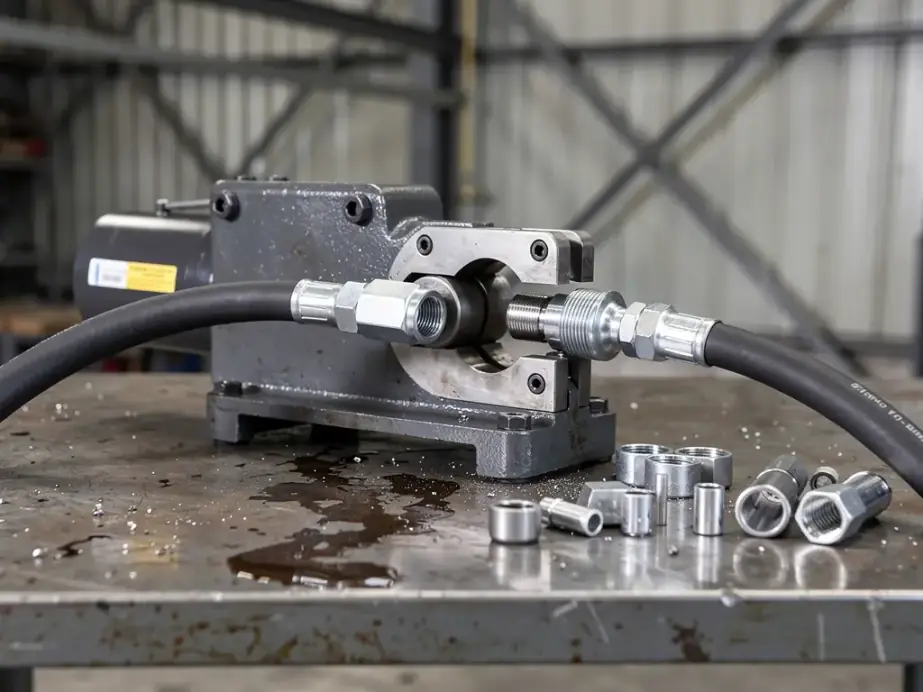
A hydraulic hose that lets go while a machine is under load can shut a job down in seconds, but the hose itself is usually trying to tell you something before that happens. The outer cover wears thin in one spot, a section starts to feel harder or softer than the rest of the hose, or a small weep shows up at a fitting days before the line actually fails. Catching those signs early is the difference between swapping a hose on your own schedule and losing a piece of equipment in the middle of a run.
Abrasion Wears Through the Cover From the Outside In
The most common way a hydraulic hose fails is simple abrasion. Anywhere a hose rubs against a frame rail, another hose, a moving part, or the ground, the outer rubber cover slowly wears away. Once that cover is gone, the reinforcement layer underneath is exposed directly to dirt, moisture, and friction, and it degrades much faster without the cover protecting it. A hose that's rubbed shiny or has a visibly thinned patch of cover, even if it isn't leaking yet, is on borrowed time. Routing a hose so it can't contact anything while the machine is moving, or adding a sleeve or guard where contact can't be avoided, is usually cheaper than the hose it would otherwise cost you.
Heat and Age Change the Rubber Itself
Rubber hardens as it ages, and heat speeds that process up considerably. A hose that's been running near an engine, an exhaust manifold, or a hot hydraulic reservoir for a few seasons can look fine from a distance while the material underneath has gone stiff and brittle. That loss of flexibility is what leads to cracking, and cracking is what leads to a sudden failure instead of a slow, catchable one.
- A cover that's gone hard, glossy, or brittle instead of staying pliable
- Fine cracks running around the hose, especially near a fitting or a bend
- Any bulge or soft spot when the hose is pressurized
- A cover that's faded or chalky from sun and heat exposure
- Fittings that show rust or corrosion where they meet the hose
A Tight Bend Radius or a Kink Shortens Life Fast
Every hydraulic hose has a minimum bend radius, and running it tighter than that, even once, stresses the reinforcement layers in a way that doesn't reverse. A kinked hose restricts flow and creates a weak point that tends to fail right at the kink, often without much other warning. When you're routing a new hose or checking an existing one, look for any point where it bends sharply rather than in a smooth curve, particularly right at a fitting, and give it more room if you can.
A Leak at the Fitting Isn't Always the Hose's Fault
When fluid shows up at a crimped fitting, it's easy to assume the hose has failed, but the fitting itself, the crimp, or the port it's threaded into can just as easily be the source. A loose fitting, a worn O-ring, or a mismatched thread can weep long before the hose assembly itself has a problem. Wiping a suspected leak clean and watching it under light pressure for a minute usually shows exactly where the fluid is coming from, which saves you from replacing a hose that didn't need it.
What a Replacement Hose Actually Gets Matched On
A correct hydraulic hose replacement isn't just the same length as the old one. It's matched on inside diameter, so flow and pressure drop stay right for the system; pressure rating, so the hose is rated well above the system's working pressure and any spikes it sees; the fitting ends on each side, since thread types and seal styles aren't interchangeable; and the finished length between fittings, measured the way the hose will actually sit once it's routed and crimped, not stretched out flat on the ground. Get any one of those wrong and you end up with a hose that fits but doesn't perform, or doesn't fit at all.
Howard's keeps a huge inventory on hand at the store on Gulfway Drive in Port Arthur and offers quick hose and tube fabrication. In their own words: don't let a broken hose grind your production to a halt, let us make the part right here, right now. Call 409-982-9478 with the size, pressure rating, fittings and length you need.
Howard's Auto & Industrial Supply, (409) 982-9478
Call (409) 982-9478More articles
Diesel Warning Signs Worth a Diagnostic Before They Get Worse
A diesel engine usually signals trouble well before it strands you. Here's what those signals mean.
How to Make a Parts Counter Trip Faster
A little prep before you walk in is usually the difference between one trip to the counter and two.