Hose or Tube: Which Does Your Equipment Need?
Hose and tube both carry fluid, but they fail in different places. Here's how to tell which one a run needs.
September 23, 2026 · 4 min read
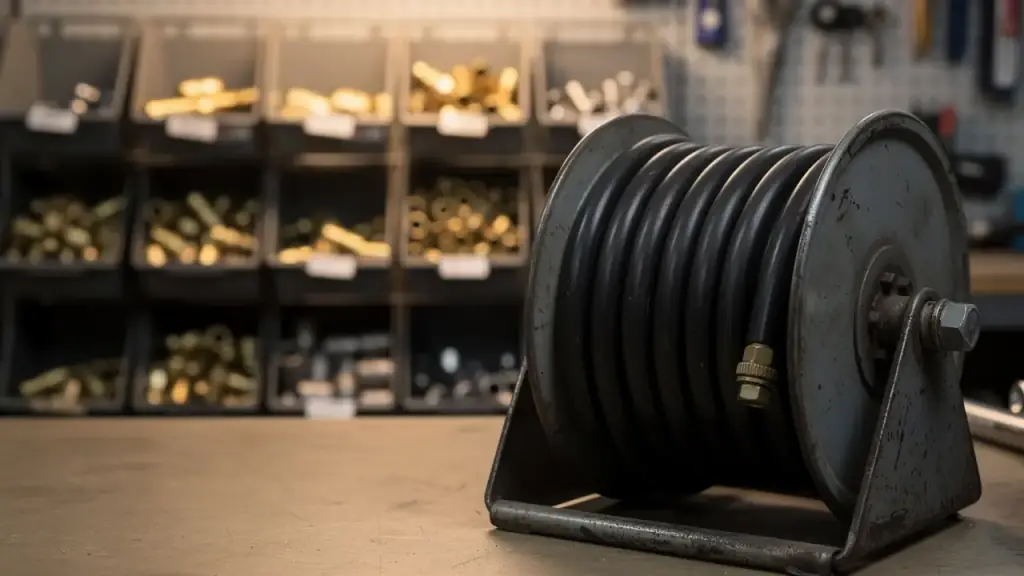
Hose and tube both carry fluid from one point to another, and people order one when the other would have served better more often than you'd expect. The difference comes down to one question: do the two ends of the line ever move relative to each other? If they do, you usually want hose. If they never do, tube is often the cleaner answer. Most real equipment uses both, and knowing which spot calls for which saves a repeat order.
Where Hose Earns Its Place
Hose bends, gives a little, and soaks up vibration. That makes it the natural choice anywhere one end is bolted to something that moves and the other end isn't. A line from a frame-mounted pump to a cylinder on an arm is one example. A line from the chassis to an engine that rocks on its mounts every time it starts and shuts down is another. A rigid line in either spot gets worked back and forth until it cracks at a bend or a fitting. Hose also helps when a run has to snake around obstacles you can't measure precisely, or when the machine gets serviced often and lines have to be disconnected and swung out of the way.
Hose has limits of its own. Every hose has a minimum bend radius, and pulling it tighter than that weakens it for good. A hose that gets twisted while the fitting is tightened will try to untwist under pressure, which loosens the connection and shortens the hose's life. It needs enough length to travel through the machine's full range of motion without pulling tight, but not so much that it loops down and drags on a frame rail or the ground. Rubber also ages. Heat, sunlight, and rubbing harden and wear the cover, so hose is a wear item in a way tube usually isn't.
Where Tube Makes More Sense
Tube is rigid metal, bent to a shape and held in place with clamps. On a long run that stays put, along a frame rail or across a machine bed, tube is neat, holds its route, and doesn't sag or rub through anything. It tolerates heat and weather better than rubber, and it doesn't harden with age. A well-routed tube run is also easy to inspect, because it stays where you left it.
The catch is that tube has to be supported. An unclamped length on a vibrating machine will resonate until it cracks, usually right where it meets a fitting. Clamps along the run, fastened to something that moves with the tube, are what keep it alive. Tube also has to be bent to the right shape before it goes on. You can't nudge it half an inch to line up with a port the way you can with hose, and forcing a tube that's slightly off puts a strain on the fitting that shows up later as a weep.
Using Both on the Same Machine
A common layout is tube for the long fixed stretch and a short piece of hose at each end, where the line meets something that moves or vibrates. The tube carries the fluid along the frame, and the hose absorbs the motion at the pump, the cylinder, or the engine. If a line keeps failing at the same fitting, ask whether it's a rigid connection between two things that move differently. A short length of hose in that spot often ends the repeat failures.
What to Write Down Before You Order
Whichever one you're replacing, a few facts about the line decide what the right part is. Get these down before you call or drive over.
- The fluid it carries, whether hydraulic oil, fuel, coolant, or air, since the material and the fittings depend on it
- The working pressure of the system, and whether it sees spikes
- How hot the line runs, and how close it sits to an exhaust or engine block
- The size at each end, plus the fitting style and thread on each end
- The length between connections, measured along the path the line will follow once it's routed
- Whether either end moves, and how far it travels
Bring the old line if you have it. It shows the diameter, the ends, and the length, and the wear on it often tells you what went wrong. A shiny rubbed patch means it was touching something. A crack next to a fitting means it was flexing where it shouldn't. Knowing that before you order lets you fix the cause along with the part, so the replacement doesn't fail the same way.
Howard's sells auto and industrial parts at the store at 3301 Gulfway Drive in Port Arthur and offers quick hose and tube fabrication. Call 409-982-9478 with your fluid, pressure, sizes, and length.
Howard's Auto & Industrial Supply, (409) 982-9478
Call (409) 982-9478More articles
The Warning Signs Before a Hydraulic Hose Fails
Most hydraulic hoses try to warn you before they let go. Here's what to look for and how a replacement is matched.
Diesel Warning Signs Worth a Diagnostic Before They Get Worse
A diesel engine usually signals trouble well before it strands you. Here's what those signals mean.